Analemmatic vs Horizontal Sundials: Which Design Suits Your Garden?
A sundial has to do two jobs at once: tell time and look as though it belongs where it stands. Those two demands pull in different directions. A dial that reads to the minute can be fussy to site, while a generous garden sculpture that invites people to walk on it will never give you railway time. The two designs most people end up choosing between — the horizontal dial and the analemmatic — sit at opposite ends of that trade-off. One is a precise instrument on a pedestal. The other turns the person reading it into part of the mechanism.
Two Ways to Catch a Shadow
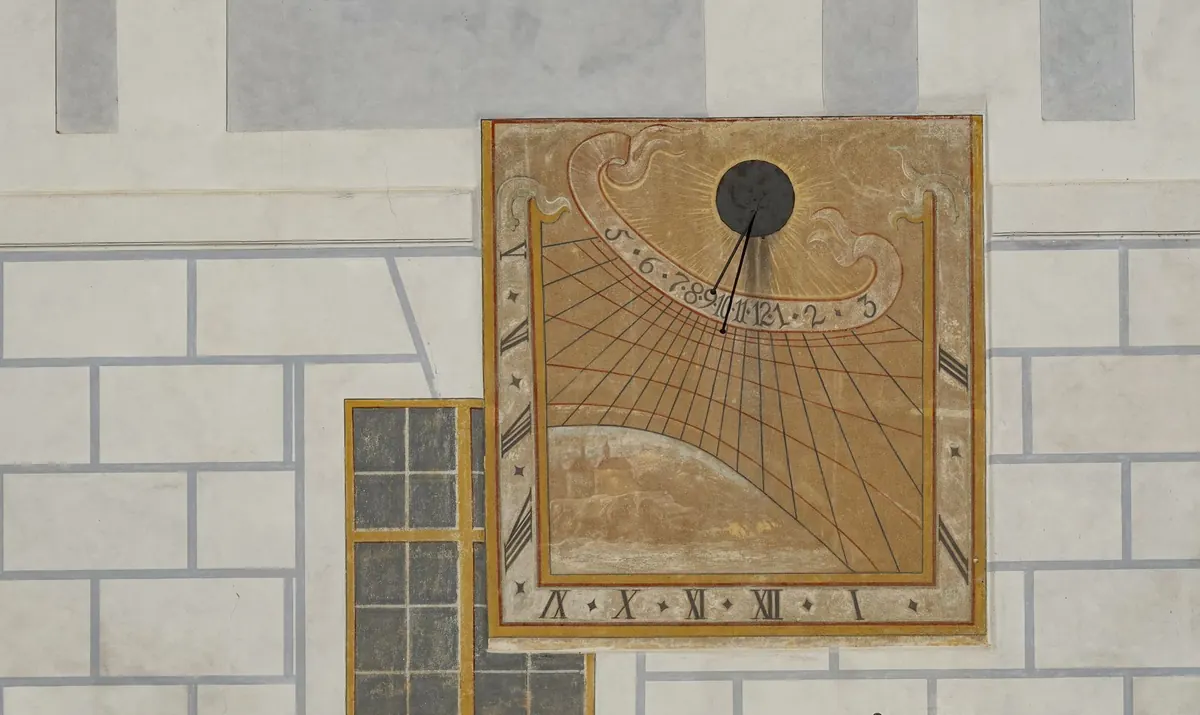
A horizontal dial lies flat, its face parallel to the ground. The gnomon — the raised fin, often called the style — is tilted so that its working edge points at the celestial pole. In practice that means the style rises above the dial plate at an angle equal to your latitude: about 51.5 degrees in London, closer to 39 in Lisbon, nearly 34 in Los Angeles. Because that edge stays parallel to Earth's axis, the sun swings its shadow across the plate at a steady rate, and the hour lines fan out from the foot of the style accordingly.
The analemmatic dial takes the same geometry and turns it inside out. There is no fixed gnomon at all. Instead you get an ellipse of hour marks set flat into paving, with a straight date line running north–south through the middle and labelled with months. You stand on the mark for the current month and your body casts the shadow. As the seasons change, the sun's height changes and so does your shadow's length, which is why you step closer to the centre in summer and further out in winter. The ellipse is also latitude-shaped: near the equator it flattens to something close to a straight line, while at high latitudes it rounds toward a circle.
Everything else follows from that one difference. The horizontal dial has a fixed, thin, carefully angled shadow-caster. The analemmatic has a moving, wide, vertical one — you.
Accuracy: The Honest Numbers
Both designs show apparent solar time, not clock time, so both need the same two corrections. The equation of time shifts true solar noon by up to about a quarter of an hour either way across the year. Longitude does the rest: every degree you sit away from your time zone's standard meridian is worth four minutes. If you want a dial that agrees with your watch, have the hour lines offset for longitude and add a small table or a figure-eight curve for the date.
Beyond that, the horizontal dial wins comfortably. A well-cut style casts a crisp edge, and a dial laid out with care can be read to two or three minutes by someone standing over it. Most of the remaining error comes from the corrections above, not from the dial itself.
An analemmatic dial is a coarser instrument, and it is honest about it. You get hour marks, not minutes. Errors creep in from three places: standing a hand's width off the month mark, swaying while you read your own shadow, and being the wrong height. The ellipse is scaled for one specific gnomon height — usually an average adult — so a tall visitor reading a dial built for someone shorter will see the shadow fall slightly past the mark. A realistic reading is within five to fifteen minutes.
One refinement is worth knowing about. Good analemmatic dials shape the date line as a gentle curve rather than a straight strip, so that standing on the right date automatically absorbs the equation of time. Ask for that if you commission one; it removes the largest single error at almost no extra cost.
Space, Scale, and the Shape of a Garden
Horizontal dials scale with the style. Make the style taller and the shadow reaches further, so the plate must grow with it — doubling the style height roughly doubles the plate you need. A modest pedestal dial with a 15 cm style will sit happily on a 35 cm plate. Early-morning and late-evening hour lines run away to nothing, which is why most garden dials simply stop at six in the morning and six in the evening. Nobody is deadheading roses at four.
Analemmatic dials are the opposite: they are floor-level and they are big. Because the hour points must be reachable by a person's shadow, the ellipse scales with human height. For an adult at mid-latitudes, expect something in the region of four to six metres across. That is a patio, not a plinth. Small tabletop versions with a removable vertical peg do exist and work on the same principle — the peg's height sets the scale — but the garden version needs a clear, level, paved circle with a metre of walking room around the rim.
Reading It Without Fuss
A horizontal dial asks nothing of you. Walk up, glance at the shadow's edge, walk away. The main design decision is the gnomon: a thick or decorative one gives a soft, wide shadow and a vague reading, so keep the shadow-casting edge thin and let ornament live elsewhere on the dial.
An analemmatic dial needs a small performance from every reader, and first-time guests will get it wrong unless the paving tells them what to do. A few details make the difference:
- Engrave an instruction at the centre — “stand on the current month” in plain words beats any symbol.
- Use high contrast: pale numerals on dark paving, or metal markers set into a darker ground.
- Label every month, not just the solstices and equinoxes; half the year is otherwise guesswork.
- Mark north clearly on the dial itself so visitors can orient without a compass.
- Keep the whole ellipse free of pots, furniture and trailing plants, or someone will stand on the wrong month without noticing.
The payoff is social. Children understand a sundial they have to stand inside, and a group can gather around one while somebody explains it. A pedestal dial is admired from a distance; an analemmatic dial gets used.
Placement and Light
Both designs want the same thing from the sky: an unobstructed view of the southern horizon if you are in the northern hemisphere, and the northern horizon if you are south of the equator. Before you commit to a spot, watch it through a day in each season and check these points:
- Direct sun from mid-morning to mid-afternoon at the very least; a dial in shade for four hours is half a dial.
- No tall trees, hedges, walls or buildings to the south — including the neighbour's leylandii, which will grow.
- Ground that is genuinely level and drains well, since standing water ruins markings and frost lifts paving.
- Distance from paths and doors for a pedestal dial, so nobody walks into the gnomon; the reverse for an analemmatic, which wants foot traffic.
- For an analemmatic, a surface that stays clean and cool enough to stand on barefoot in summer.
Alignment is the other half of accuracy. A horizontal dial must be set level and its noon line pointed at true north, not magnetic north; the difference between the two is substantial in many places and is a common cause of a dial that runs mysteriously early or late. An analemmatic dial has the same requirement in a less forgiving form, because a large ellipse set a few degrees off will never read cleanly and cannot easily be rotated once the paving is laid.
Making the Choice
Choose a horizontal dial if you want a reading instrument, if your space is a narrow border or a walled terrace, and if you would rather buy or build something you can lift into place with two people. Choose an analemmatic dial if you have a generous flat area, if the garden is used by children or visitors, and if you accept that you are commissioning a piece of ground rather than an ornament.
- Measure your clear, sunlit, level area. Under two metres of width, a horizontal dial is the only sane option.
- Decide how precise you need it to be. If you want a dial that matches your watch, go horizontal and have the hour lines offset for longitude.
- Think about who will read it. Guests and children will use an analemmatic; a formal parterre wants a pedestal.
- Set the dial for your latitude, not the latitude in a kit's instruction sheet, and align to true north.
A last piece of practical advice: build a cardboard or chalk mock-up of either design at full size before any stone is cut. Stand in it at ten in the morning and again at three. An hour of chalk on paving will tell you more about which dial suits your garden than any drawing.
Photo: Magda Ehlers / Pexels