How to Find True North with a Stick and Shadows: A 15-Minute Guide
True north is not where the compass says it is. It is where the shadows say it is — and on any sunny afternoon, a stick and a handful of pebbles will tell you in about fifteen minutes. That is enough precision to set up a sundial, to point an equatorial mount, or to work out where to stand when the Perseids arrive at two in the morning.
The method is old enough that nobody gets credit for it. It needs no battery, no calibration, and no view of the horizon. It only asks for sun, patience, and a willingness to mark the ground properly.
North, and the North That Matters
A magnetic compass points at something in the ground, not something in the sky. The difference between magnetic north and true north — the declination — varies hugely with where you stand. In parts of northern Canada it is large enough to throw you off by a substantial fraction of a right angle; in other places it is close to nothing. Unless you know the local value and apply it correctly, a compass reading is a rough hint at best.
For astronomy, that hint is not good enough. A sundial's hour lines are drawn around true north. A telescope mount tracks the sky around the celestial pole, which sits almost — but not quite — above true north. A star chart rotated to the wrong north puts the wrong constellations over the wrong trees. Shadows, awkwardly, are tied to the actual Sun, which is tied to the actual axis of rotation. That is the whole appeal: the thing casting the shadow is the thing you are trying to align with.
What You Need, Which Is Almost Nothing
- A straight stick, roughly 60–100 cm long. A bamboo cane, a broom handle, a garden stake. Straight matters more than tall, but tall helps.
- A flat, level patch of ground with sun on it for several hours. A patio, a driveway, a mown lawn, a beach.
- A plumb line or a small spirit level to get the stick vertical. Eyeballing it costs you accuracy later.
- Small markers: pebbles, tent pegs, chalk, or golf tees. Chalk on paving is the easiest.
- A watch, if you want to mark at fixed intervals, and a length of string if you want the cross-check described below.
- Something to sit on, plus a hat. You will be crouching and squinting for a while.
Marking the Shadow
Work in the middle of the day, and start early enough that you have two or three hours of sun left. Morning and afternoon are better than the hour either side of noon, for a reason that becomes obvious once you try it: near midday the shadow tip barely moves.
- Find your patch of ground and check that it is level. A slope of a few degrees tilts your entire result.
- Drive the stick into the ground, or stand it in a weighted pot, and use the plumb line to make it vertical. Mark the exact point where it meets the ground — this is the origin for everything that follows.
- Note the time. Wait ten to fifteen minutes.
- Put a marker precisely at the tip of the shadow, not the middle. Get your eye down to ground level so you are not introducing parallax. A sharpened stick top or a nail pushed into the end of a wooden stake makes a much finer shadow point than a blunt one.
- Note the time again and repeat. Keep going for an hour and a half to two hours, marking at even intervals.
- Stand back and look at what you have made: a shallow curve of markers sweeping across the ground.
Mark the tip, not the middle. The tip is the only part of the shadow that carries usable information.
Reading the Curve
The shortest-shadow rule
One point on that curve is closer to the base of the stick than all the others. That is the shortest shadow of the day, cast when the Sun is highest — at local apparent noon. The line running from the base of the stick through that closest point is your north–south line. In the northern hemisphere, the shadow at that moment points north. South of the equator, it points south instead, and the whole procedure mirrors.
To fix the line, lay a straight edge — a plank, a taut string, a garden cane — from the stick's base through the closest mark. Extend it well beyond the curve. Then set out a perpendicular to it, using the 3-4-5 trick or a large compass, and you have east and west as well. From there, a right angle is all the surveying you need.
The equal-length cross-check
If you would rather not judge "closest point" by eye, tie a string to the base of the stick and cut it to the length of the current shadow. Peg it at the base and sweep it like a compass. Mark where the shadow tip crosses that arc in the morning, and again where a shadow of the same length crosses it in the afternoon. Those two crossings are equally distant from noon, so the line joining them runs east–west, and the perpendicular through the stick's base is true north.
Doing both methods on the same afternoon is a good habit. When they agree, trust the result. When they disagree by more than a couple of degrees, something moved — usually the stick, or your foot on a marker.
Getting Closer Than "Roughly"
A careful fifteen-minute version will land you within a few degrees. An hour of unhurried marking on level ground gets considerably better. The refinements that matter most:
- Use a taller stick. Doubling the height roughly doubles the length of the shadow and the distance the tip travels, which shrinks the effect of your marking error.
- Mark for longer, centred on the middle of the day, so the curve is well defined on both sides.
- Choose a crisp-shadow day. Thin cloud softens the tip into an indistinct smear.
- Re-level the ground. An unnoticed slope is the most common source of a two- or three-degree error.
- Repeat on another day and see whether your line lands in the same place. If it does, you have a reference you can trust.
One point that confuses people: clock noon is almost never the moment of shortest shadow. Time zones are wide, daylight saving shifts everything by an hour, and the Sun runs a few minutes fast or slow through the year depending on the season. You do not need to calculate any of this. Finding the shortest shadow sidesteps the entire problem, because the shadow is measuring the Sun directly.
From North to Sundial and Star Chart
For a sundial, your north–south line is the foundation. The gnomon — the edge that casts the time-telling shadow — must lie parallel to Earth's axis, which means pointing at true north and rising at an angle equal to your latitude. Chalk the line on the patio while the marks are still fresh and you will not have to find north again.
At night, the same line earns its keep. It gives you a starting point for locating Polaris, which sits within about a degree of the celestial pole and is the anchor for polar-aligning an equatorial mount. It tells you which way is which when you are setting up in an unfamiliar field in the dark. It lets you plan where a rising constellation will appear above the treeline before it gets there, so you can position a telescope and a chair and be comfortable when the good part of the night arrives.
A Quarter of an Hour That Keeps Paying
Pick a bright afternoon this week, plant a stick in the lawn, and mark the shadow tip every twelve minutes for an hour and a half. Pour the coffee, keep the markers small, and resist the urge to hurry the last few points. Then chalk the north–south line somewhere permanent: a paving joint, a fence post, a dab of paint on the wall of the shed.
You will use it more than you expect. Setting up a mount, judging where a meteor shower will radiate from, checking whether the tree at the end of the garden will block the Moon at totality — all of it gets easier once one line on the ground is trustworthy. Fifteen minutes of a sunny afternoon buys a reference that lasts for years, and it costs a stick.
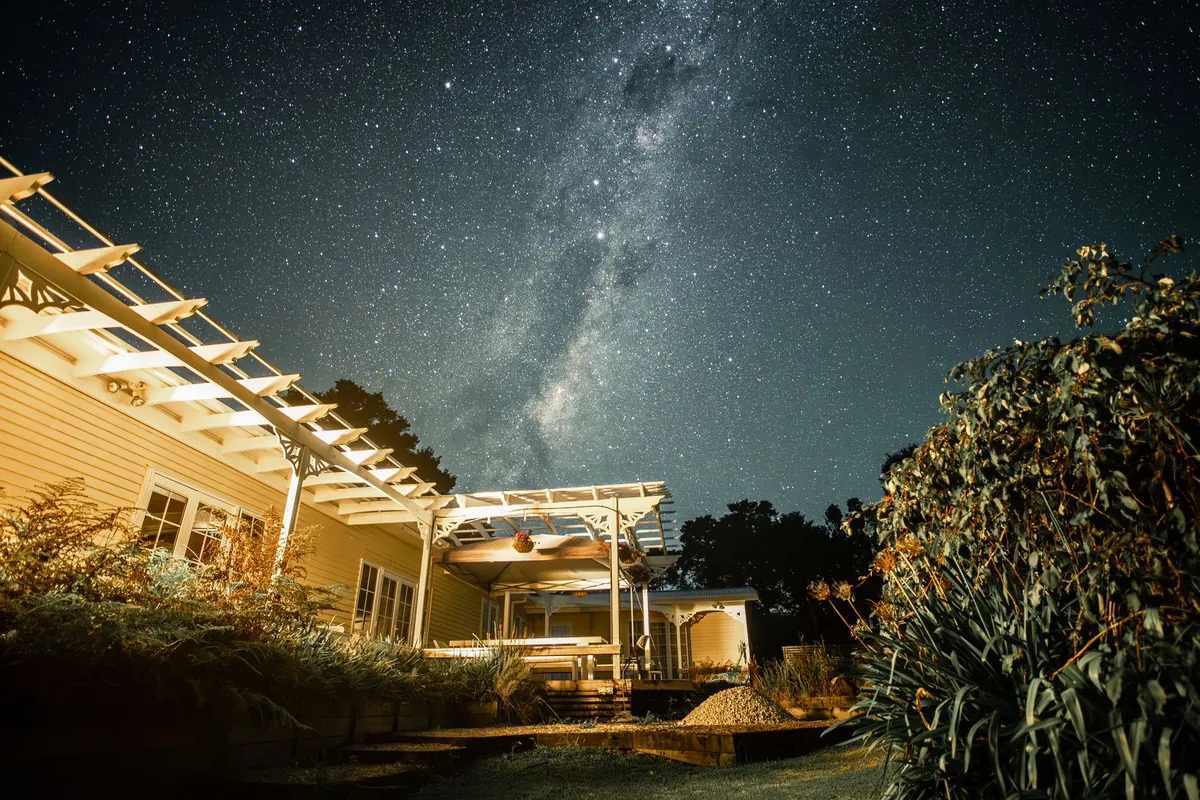
Photo: eliasfalla / Pixabay