Local Solar Time vs Standard Time: Why Clock Noon Is Not Solar Noon
Local Solar Time vs Standard Time: Why Clock Noon Is Not Solar Noon
Stand outside at what your phone calls noon and look at your shadow. On most days it will not line up exactly with the north–south meridian, and the Sun will not be at its highest point. Clock noon is a human agreement. Solar noon is an astronomical event. The difference between them comes from longitude, time-zone politics, daylight saving time, and the Sun’s own seasonal irregularity. Once you see those pieces separately, the gap stops looking like an error and starts looking like a map of where and when you are.
The gap is usually small enough to ignore during a lunch break, but it is not random. It changes as you drive east or west, as the seasons turn, and as governments decide which offset a region should use. A town near the western edge of a wide time zone can experience solar noon more than an hour after the clock says noon. A town near the eastern edge can experience it before the clock does. The Sun keeps its own schedule; the clock keeps ours.
The two noons: an event and an agreement
Solar noon is the instant the Sun crosses your local celestial meridian—the great circle that runs from due north through the zenith to due south. At that moment the Sun reaches its highest altitude for the day, and shadows are shortest. The time that passes from one solar noon to the next is a solar day. It is close to 24 hours, but not exactly constant, because the Earth’s orbit is slightly elliptical and its axis is tilted.
Clock noon is simpler and more artificial. It is the moment your timekeeping system says 12:00. In a standard time zone, every clock in the zone usually shows the same time, even though the Sun cannot be on the meridian for everyone at once. Civil time is designed for trains, meetings, broadcasts, and computers. Solar time is designed for the Sun. They are related, but they are not the same thing.
This is why a sundial can disagree with a wristwatch without either one being broken. The watch is answering a social question: what time have we agreed to call it? The sundial is answering a geometric one: where is the Sun relative to this patch of ground? The difference between those answers is what we mean by the equation between solar time and standard time.
Clock noon is a social fact; solar noon is an astronomical one. The distance between them is a small measurement of geography, policy, and the geometry of the sky.
Longitude sets the original clock
The Earth turns once in about 24 hours, so it turns through 360 degrees in 24 hours, or 15 degrees per hour. That gives a useful conversion: one degree of longitude equals four minutes of time. A place one degree west of another sees solar noon about four minutes later. A place one degree east sees it about four minutes earlier. At the scale of a city, that is small. At the scale of a country, it is not.
Before standard time, many towns kept local mean time—time based on their own longitude. That worked until travel and telegraphy made the differences inconvenient. A railway timetable that mixed dozens of local times was a recipe for missed connections and collisions. Standard time zones bundled longitudes together and chose a central meridian for each offset. The system is a compromise: it keeps clocks convenient across a region while accepting that the Sun’s actual crossing of the meridian will drift from clock noon as you move east or west inside the zone.
In other words, standard time did not abolish solar time. It rounded it off, stretched it across political borders, and then asked everyone in the region to pretend the rounding was natural. The Sun was not consulted.
Time zones bend the geometry
Each standard time zone has a reference meridian. For Central European Time, that meridian is 15 degrees east. If you stood exactly on it, ignored daylight saving, and allowed for the Sun’s seasonal wobble, mean solar noon would fall near 12:00 on the clock. Move west of that line and solar noon arrives later by the clock. Move east and it arrives earlier.
A city near 12.5 degrees east, for example, lies about 2.5 degrees west of the CET reference meridian. Multiply by four minutes per degree, and mean solar noon falls roughly ten minutes after 12:00 standard time. In summer, daylight saving adds another hour, so the same mean solar noon sits near 13:10 on the clock. That single example shows why “noon” on a watch can feel late or early depending on the season.
Zone boundaries make the mismatch larger. They follow national borders, state lines, and administrative choices rather than clean meridians. Some countries use one official time across a span of longitude that would naturally deserve several. China, for instance, keeps one standard time across a very wide country, so solar noon in western China can arrive hours after clock noon. Spain sits far west within Central European Time, and parts of the country can see solar noon well into the afternoon by the clock, especially in summer. India uses a single half-hour offset, which is a compromise between its eastern and western extremes. These are political and practical choices, not astronomical ones.
The result is that two places at the same longitude can share solar noon but not clock noon, while two places in the same time zone can share clock noon but experience solar noon at very different moments.
Daylight saving adds an hour of politics
Daylight saving time shifts the clock without shifting the Sun. When clocks spring forward, clock noon moves one hour earlier relative to the Sun; in everyday terms, solar noon now appears one hour later on the clock. When clocks fall back, that hour is removed again. The Sun’s transit does not care, but the label on the clock does.
This is why summer afternoons can feel oddly bright at a late hour in regions that use daylight saving. The Sun is not staying up later. The human schedule has been moved so that more of the daylight falls after the clock’s morning. Daylight saving is a policy about waking, working, and evening light. It is not a correction to solar time.
Some places do not observe daylight saving at all. Others have tried permanent daylight saving or permanent standard time. Each choice changes the relationship between clock noon and solar noon for everyone in that jurisdiction, often by a full hour at once.
The Sun’s seasonal wobble: the equation of time
Even if you stood on a time zone’s reference meridian and ignored daylight saving, clock noon and solar noon would still not match perfectly every day. The Sun is not a perfect timekeeper. Earth’s orbit is elliptical, so the planet moves faster when it is nearer the Sun and slower when it is farther away. Earth’s axis is also tilted, which changes how the Sun’s apparent motion is projected onto the sky. Together these effects produce the equation of time: the difference between apparent solar time and mean solar time.
The equation of time makes solar noon arrive a little earlier or later than its average position by roughly a quarter of an hour over the course of the year. If mean solar noon would fall at 12:10 on the clock, apparent solar noon might occur near 11:54 on one date and near 12:26 on another. The Sun can be “fast” or “slow” compared with the average clock. A graph of this effect, often drawn as a figure-eight analemma, shows how the Sun’s position at noon wanders through the year.
This seasonal wobble is small compared with a time-zone boundary or daylight saving, but it matters for precise work. It is the reason a sundial requires a correction table if you want to compare it with civil time, and it is why the earliest and latest solar noons do not fall neatly on the solstices.
Putting the offsets together
To estimate the difference between clock noon and solar noon for a given place and date, you can separate the problem into pieces:
- Longitude offset: compare your longitude with the time zone’s reference meridian. West of the meridian means solar noon is later by the clock; east means earlier.
- Zone shape: account for the fact that political boundaries can place you far from the reference meridian.
- Daylight saving: add or subtract the seasonal clock shift if your region observes it.
- Equation of time: add the Sun’s seasonal fast or slow correction, usually no more than about a quarter of an hour.
For the city near 12.5 degrees east in Central European Time, the longitude offset is about ten minutes later, and summer daylight saving makes it about seventy minutes later. The equation of time can then nudge the actual solar noon earlier or later by several more minutes. The exact result depends on the date, but the logic is stable: longitude, zone politics, daylight saving, and the Sun’s own irregularity.
How to find your own solar noon
You do not need a telescope to see the difference. A simple shadow experiment can show it clearly. Choose a level patch of ground, place a vertical stick in it, and mark the tip of the shadow every few minutes around midday. The shortest shadow of the day points along the local north–south line, and the moment of that shortest shadow is local solar noon. You can also use symmetry: find two times when the shadow is the same length, one before and one after noon, and take the midpoint.
If you prefer calculation, use this sequence:
- Find your longitude and your time zone’s standard reference meridian.
- Subtract the two longitudes and multiply the difference by four minutes per degree.
- Add or subtract daylight saving time if it is in effect.
- Apply the equation of time for the date using a table or calculator.
- Compare the result with 12:00 on the clock to see when solar noon actually occurs.
The shadow method has the advantage of being local and physical. The calculation method has the advantage of being precise and repeatable. Together they make the distinction concrete: solar noon is not an abstraction, but an event you can watch.
Why the distinction matters
The difference between clock noon and solar noon is not just a curiosity for sundial enthusiasts. It affects how we design buildings, plan outdoor work, position solar panels, and interpret natural light. A south-facing window in the northern hemisphere receives its strongest direct sun around solar noon, not necessarily at 12:00 on the clock. Photographers who want short shadows or warm side light need to know when the Sun is actually high. Farmers, builders, and anyone who works outdoors can use solar time to anticipate heat and shadow.
- Solar energy: panels produce most when the Sun is highest, so solar noon helps with orientation and performance estimates.
- Photography and film: shadow length, color temperature, and golden-hour timing all follow the Sun’s position.
- Architecture: overhangs, shades, and window placements are often tested against solar geometry.
- Navigation: shadow-stick methods use solar noon to find direction.
- Cultural and religious timekeeping: some traditions define prayer or ritual times by the Sun’s position rather than by the clock.
In each case, the question is not simply “what time is it?” but “where is the Sun?” Those are different questions, and the difference is largest when time zones, daylight saving, and the seasons push the clock away from the sky.
Common misconceptions
- “Noon is when the Sun is highest.” That is solar noon, not necessarily clock noon.
- “Time zones are perfect 15-degree slices.” They are political and administrative shapes, often far from ideal meridians.
- “Daylight saving changes the Sun.” It changes the clock, and therefore changes the label we put on the Sun’s position.
- “The Sun is perfectly regular.” The equation of time shows that apparent solar time drifts from mean solar time through the year.
- “Same time zone means same solar noon.” Same clock noon, perhaps, but solar noon depends on longitude and the season.
Once you separate the event from the agreement, clock noon becomes easier to interpret. It is a useful human convention layered over a moving astronomical reality. Solar noon is the reality underneath: the Sun crossing the meridian, shadows turning, and the day reaching its local peak. The gap between the two is not a flaw in the system. It is the signature of geography, policy, and the seasons written into the clock.
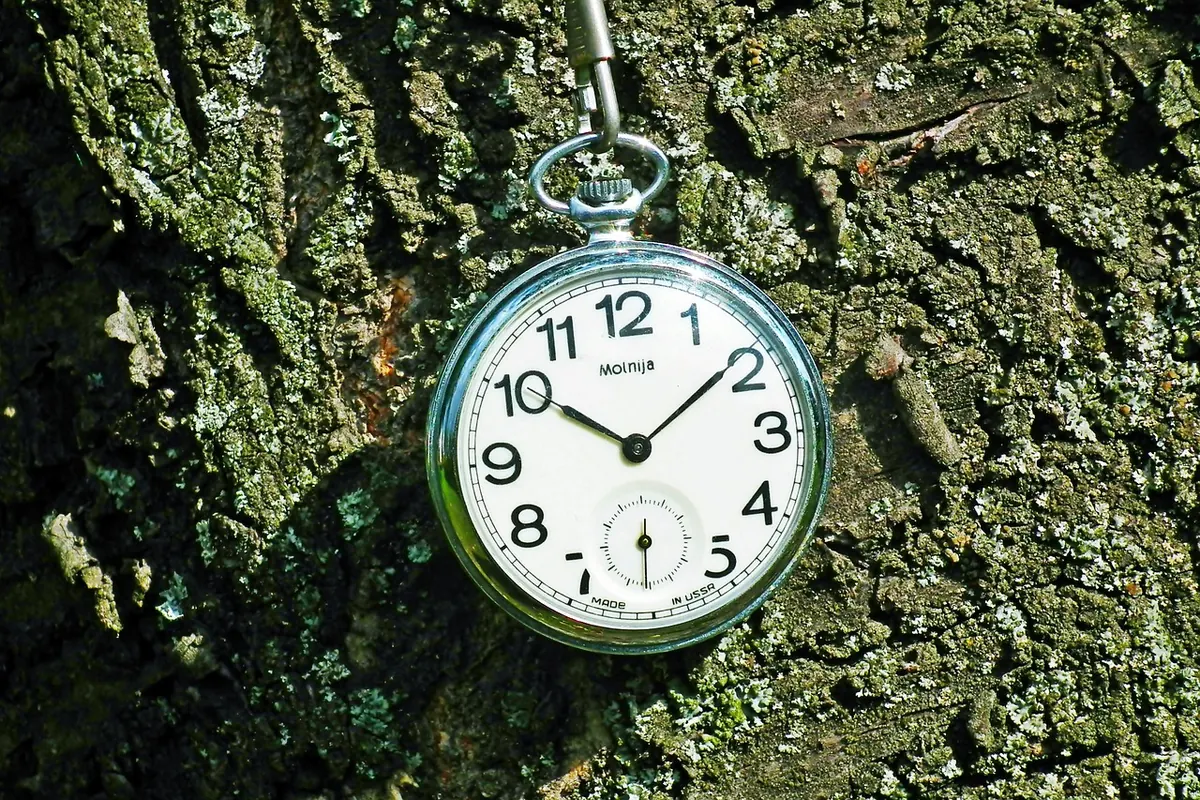
Photo: MrGajowy3 / Pixabay