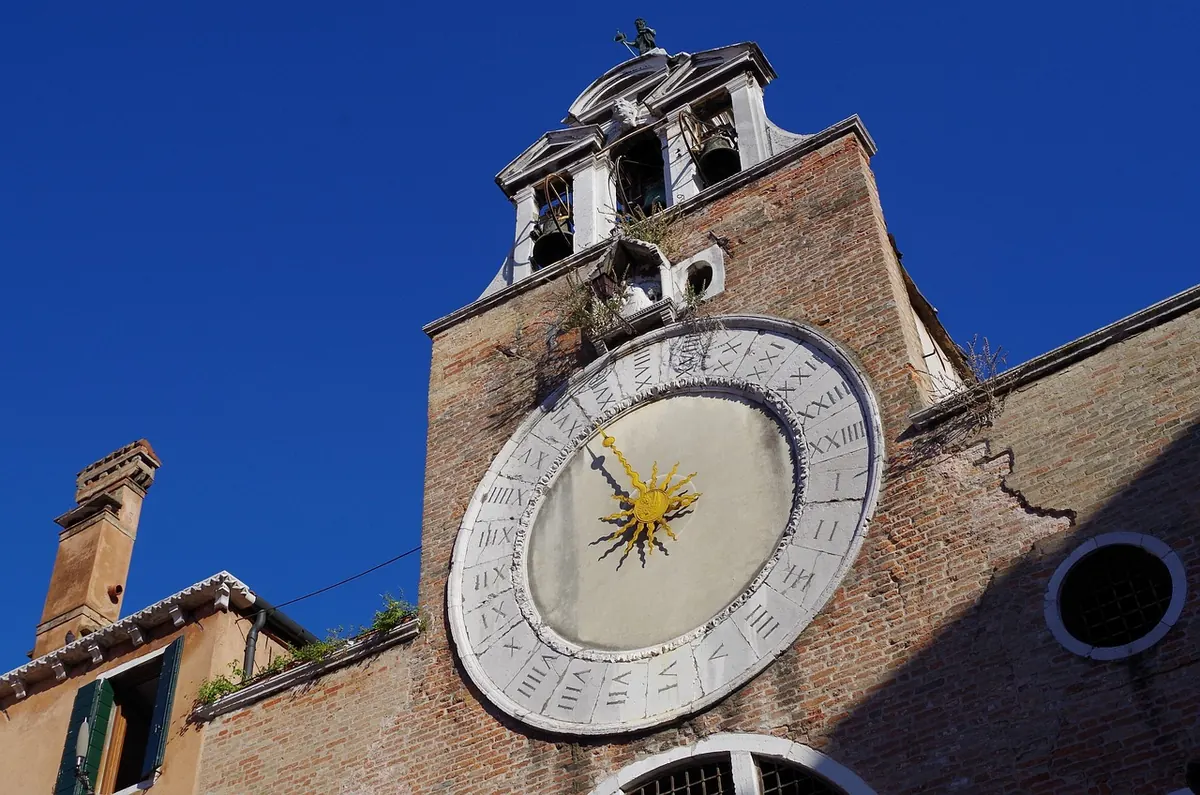
The Equation of Time Explained: Why Solar Noon Drifts All Year
Put a straight stick in the ground on level soil and mark where the shadow's tip falls at noon by your kitchen clock. Do it again next week, and the week after. By spring you will have a scattering of marks that refuse to line up — a small, stubborn smear that wanders east and west across the ground by as much as sixteen minutes of shadow. Nothing is broken. The stick is telling the truth about the Sun, and the clock is telling the truth about something else. The disagreement between them has a name: the equation of time.
Two Kinds of Noon
Sundials keep apparent solar time. Noon is the moment the Sun crosses your meridian — its highest point of the day, when shadows are shortest and point due north or due south. This is a real, observable event, and its spacing is not perfectly regular.
Clocks keep mean solar time. That is a convenient fiction: a "mean Sun" that runs around the celestial equator at a perfectly constant rate, so that every day is exactly 24 hours long. It is the time of timetables and appointments, and it deliberately smooths out the lumpiness of the real Sun.
The equation of time is simply the difference between the two, conventionally written as apparent time minus mean time. When the number is positive, the sundial is ahead of the clock. When it is negative, the sundial is behind. Over a year it swings from roughly 16 minutes fast in early November to roughly 14 minutes slow in mid-February. Four times a year the two agree almost exactly — and those dates are not the ones most people guess.
Why the Gap Exists
Two separate effects are at work, each with its own rhythm, and the equation of time is what you get when you add them together.
The tilt of the axis
Earth's axis leans about 23.4 degrees to the plane of its orbit, so the Sun's apparent path across the sky — the ecliptic — is inclined to the celestial equator. We measure time by hour angle, which is counted along the equator, but the Sun travels along the tilted path. Near the solstices the Sun's motion is aimed largely north-south, and its eastward progress along the equator is slow; near the equinoxes the reverse is true. The result is a wobble with four zero crossings a year, at the solstices and equinoxes, and extremes in between. Its size is about ten minutes.
The shape of the orbit
Earth's orbit is an ellipse, and Earth moves faster near perihelion in early January than near aphelion in early July. A faster Sun means the solar day runs slightly long for a few weeks, and slower means it runs short. This effect has a single annual cycle, with zero points near early January and early July and extremes in spring and autumn. Its size is about eight minutes.
Neither component alone exceeds ten minutes. Combined, and depending on whether they reinforce or partly cancel, they produce the familiar 14-to-16-minute range. That is why the equation of time is often drawn as a figure-eight rather than a simple wave.
The Calendar of the Drift
You do not need to memorise a table, but a handful of turning points are worth knowing. The dates below shift by a day or so from year to year.
- Around 11 February: the deepest negative value, roughly 14 minutes. The sundial is at its slowest, and solar noon arrives latest — near 12:14 by clock time if your longitude is aligned with your time zone's meridian.
- Mid-April: the two times coincide. The first of the year's zero crossings.
- Mid-May: a small secondary peak of about three or four minutes, easy to miss on a graph but real.
- Mid-June: agreement again, briefly.
- Late July: a modest dip of some six minutes, the least dramatic of the turning points.
- Early September: the third zero crossing.
- Around 3 November: the yearly maximum, about 16 minutes. Solar noon is at its earliest, near 11:44.
- Around 25 December: the fourth and final crossing, after which the drift heads back down towards February.
Notice the asymmetry: the November maximum is larger than the February minimum. That happens because the two components happen to pull in the same direction in autumn and partly oppose each other in winter.
Reading a Sundial Correctly
A sundial that has been properly set up reads apparent solar time at your exact longitude. Turning that into something you can compare with your watch takes two corrections, and it is easy to apply them in the wrong direction. Work through it in this order.
- Set the dial up properly. The gnomon — the shadow-casting edge — must point at the celestial pole. Its angle above the horizon equals your latitude, and it points true north in the northern hemisphere, true south in the southern. A dial that is off by a couple of degrees will be off by minutes at certain hours.
- Correct for longitude. Your time zone is built around a standard meridian, which is usually not yours. Each degree of longitude between you and that meridian is worth four minutes. If you are west of it, the Sun arrives later, so add those minutes to clock time to get local mean time; if you are east, subtract.
- Correct for summer time. If daylight saving is in force, subtract an hour from the clock before comparing — or add it to the sundial reading, whichever keeps you honest.
- Apply the equation of time. Look up today's value in an almanac or a reliable table. Remember that the number is apparent minus mean, so a positive value means the sundial is fast and you subtract it to find clock time; a negative value means you add.
One caution: different sources use opposite sign conventions. Some quote the correction to be applied to mean time rather than the difference itself. Read the column heading before you trust the digits.
The Analemma in Your Garden
The curve traced by the shadow tip at clock noon over a year is called the analemma, and it appears on the Pacific Ocean of many older globes. It is a narrow loop with one large lobe and one small one, pinched near the middle where the two components briefly cancel.
The shape repays a close look. The vertical spread is not the equation of time at all — it comes from the Sun's declination, high in summer and low in winter, which shortens and lengthens the noon shadow. Only the sideways wander is the equation of time. Once you separate the two, a single mark on the ground carries a surprising amount of information about the geometry of the solar system.
How to See It for Yourself
Pick a spot with a clear view towards the equator — due south in the northern hemisphere, due north in the southern — and something that will not move: a fence post, a washing line pole, a windowsill that catches the noon sun. Fix a vertical rod if you can; a plumb line or a spirit level is enough to get it close. Then mark the shadow tip at the same clock time once a week, or once a fortnight, and date each mark in pencil.
Within three months the drift will be obvious. Photograph the marks from directly above at the end of the year and you will have your own analemma, drawn at the scale of your own garden. A notebook beats memory here: record the time you measured, the date, and whether daylight saving was in force.
If you would rather watch the effect in a single afternoon, use a noon line instead. Draw a true north-south line on the ground beneath the rod and note the clock time at which the shadow crosses it. Do this in early November and again in February, and the same shadow will cross the same line nearly half an hour apart. That interval is the equation of time made visible — no instruments, no tables, just a stick, a line, and a little patience.
Photo: micakonrad / Pixabay